Benefits of Sensory Play at the Playground

Benefits of Sensory Play
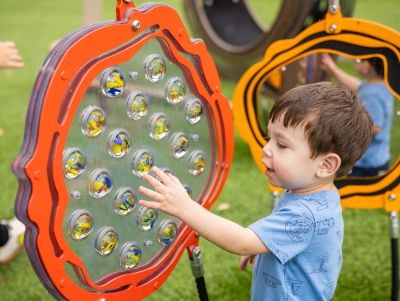 Sensory play is any activity that stimulates a child’s senses. Through sensory play, children develop behaviors based on what they touch, see, hear, taste, smell, and how they move and position their bodies in space. Diverse sensory experiences within a play environment allow children of all ages and abilities to integrate and develop their senses, and the more they play, the more they develop skills necessary to engage, change and impact the world around them.
Incorporating sensory play equipment into a playground design ensures there is something to engage children of varying needs and levels of ability. All kids benefit from sensory play exploration; however, kids with disabilities may engage with and process this equipment differently. Some may require additional sensory input while others do better with less. Some may prefer to experience this input more frequently, others less frequently. Including different types of sensory play equipment allows every child to choose how they want to engage in the play space.
Inclusive Play Starts with the Senses
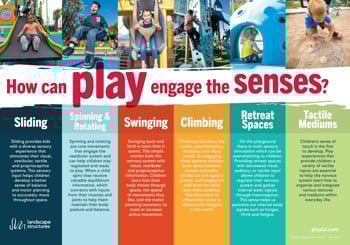 Play is a sensory experience, shaping how children move, think, and connect. Engaging tactile, vestibular, auditory senses and more, sensory-diverse play environments support development and inclusion. For children with sensory challenges, they can also aid regulation. Explore each sense and its role in play with our Senses at Play Handout.
Motor Planning: Supporting the brain-body connection
Children with dyspraxia—a subtype of Sensory Processing Disorder—often struggle with motor planning: the ability to conceive, plan, and execute new motor tasks. Designing playgrounds with varying levels of challenge, such as net climbers or belted structures, offers children chances to develop these skills in a playful, low-pressure setting.
Take, for example, a multifaceted play structure like Landscape Structures’ Volo™ Aire. This compact but component-rich play system allows kids to test different routes, adjust their bodies, and work on spatial awareness—all critical aspects of motor planning.
 Tactile Input: Engaging through touch
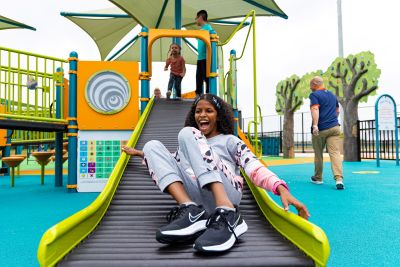
Tactile play helps children explore texture, temperature, and pressure—important sensory inputs for development. From sandboxes and water elements to roller slides made with rotating steel rollers, playgrounds can be a rich source of tactile feedback.
Tactile elements such as water features can serve as a sensory regulation tool as children transition in and out of a space. The tactile input of a gentle water spray can help some children organize their sensory systems before engaging with more stimulating, physically or visually intense play experiences..
 Vestibular Input: Finding balance through motion
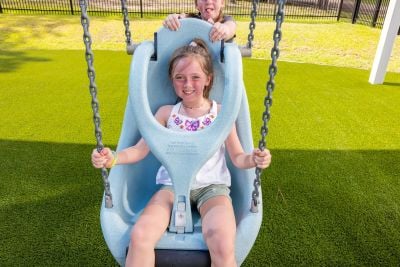
Swings are more than just fun—they stimulate the vestibular system, which helps us understand balance, connects us to gravity, therefore helping with spatial orientation. Swinging teaches children how their bodies move through space while also engaging muscles and coordination.
Offering a variety of swing options—like molded bucket seats for kids with lower postural control—creates access for more children. And placing swings on the outer edge of a play space reduces auditory and visual overload, supporting self-regulation. For many kids, this simple setup can make or break their playground experience.
Proprioception: Heavy work, big benefits
The proprioceptive system tells us where our body parts are in space and how much force to use. Activities that involve pushing, pulling, or climbing give muscles and joints the input they need to develop strength and body awareness.
Playground elements like climbers of varying materials, types and orientations provide this kind of “heavy work” in a natural, motivating way. These movements also help calm and regulate the nervous system, an often-overlooked benefit of outdoor play.
 Interoception: Recognizing internal signals
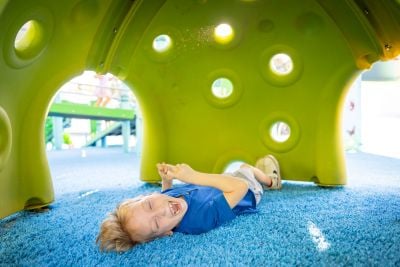
Interoception is the sense that helps us perceive internal cues like hunger, thirst, or needing a break. For children—especially those who are neurodivergent—overwhelming environments can disrupt this sense.
Providing retreat spaces like the Cozy Dome® or Fox Den Hangouts® gives kids a place to regulate without leaving the play area. These quiet zones offer reduced sensory input and empower children to recognize and respond to their internal needs in a safe, calming spot.
Auditory Input: Tuning in to sound

While some children seek out auditory input, others may be easily overwhelmed by noise. Incorporating intentional sound elements—such as the Rhapsody® Outdoor Music Instrument Collection—can both enhance play and aid in transitions.
Visual Stimulation: Seeing the world in motion
Visual exploration is another important component of play. Panels with spinning elements, mirrors, or color wheels offer dynamic, low-pressure opportunities to engage the visual system.
Visual sensory panels allow kids to manipulate marbles or spinning parts, creating patterns and motion that are both soothing and stimulating. These features are particularly helpful for children who benefit from visual predictability or who love to seek out cause-and-effect play.
Sensory Play Expert Partners
 The sensory-diverse, inclusive play experiences we design wouldn't be possible without the partnership of our allies in the world of inclusion. Our Inclusive Play Partners are central to how we work—bringing expertise and lived experience in child development, adaptive recreation, occupational therapy, and sensory processing directly into our process.
 Their guidance shapes everything from early concepts to final play experiences, ensuring each environment thoughtfully supports a wide range of sensory needs, abilities, and developmental stages. This isn’t a one-time consultation—it’s an ongoing collaboration that grounds our work in real research, lived experience, and evolving best practices.
Through dialogue, shared insights, and hands-on feedback, these partners help us push beyond baseline accessibility toward creating better sensory experiences in play environments. The result is more than inclusion—it’s play that feels seamless, welcoming, and meaningful for every child.
Key collaborators in this space include our Inclusive Play Specialist, Dr. Ariel Mansholt, OTR/L, and the STAR Institute for Sensory Processing, whose expertise continues to inform and elevate our approach to sensory and inclusive design.
 Oops! The Internet Explorer (IE) browser is no longer supported.