The Many Ways We Play Information & References
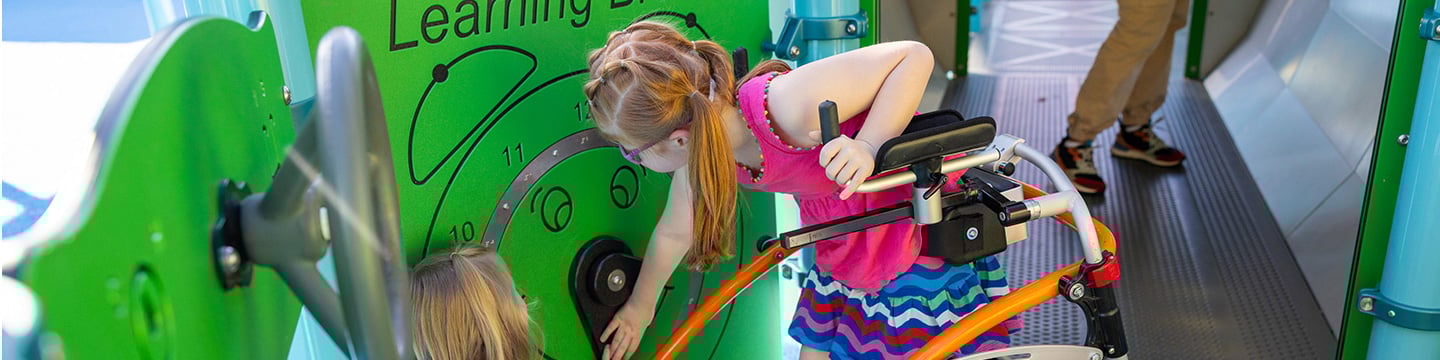
Every child plays differently. And the way they play is shaped by how they experience the world. The Many Ways We Play celebrates those differences.
Understanding the Experience of Children with Disabilities
The Many Ways We Play brochure is an invaluable resource for anyone dedicated to inclusive play. It provides a deeper understanding of how children with disabilities experience the playground. Organized by diagnosis, it provides insights into how a child might move, interact, and engage with their environment, and includes examples of playground features that best support these kids' experience.
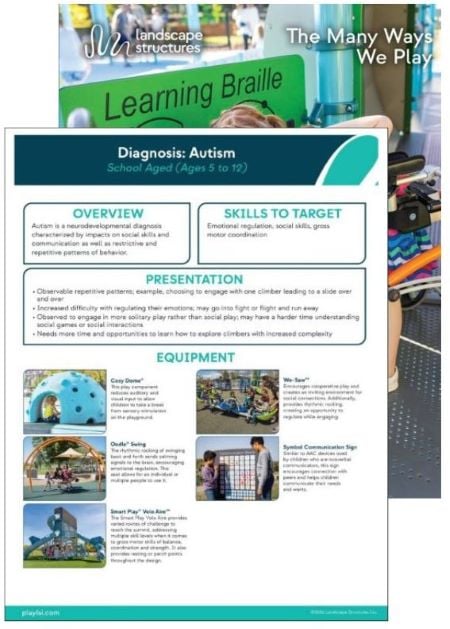 The brochure explores these diagnoses:
|
|
|
|
|
|
|
|
|
|
|
|
Author Ariel Mansholt is a pediatric and adolescent occupational therapist with both clinical expertise and personal experience in inclusive play. See her full biography below.
The insights in The Many Ways We Play are supported by Dr. Mansholt's studies in occupational therapy, child development and disability. These references are the source material for the brochure.
Dr. Ariel Mansholt, OTD, OTR/L, CPSI, Inclusive Play Specialist
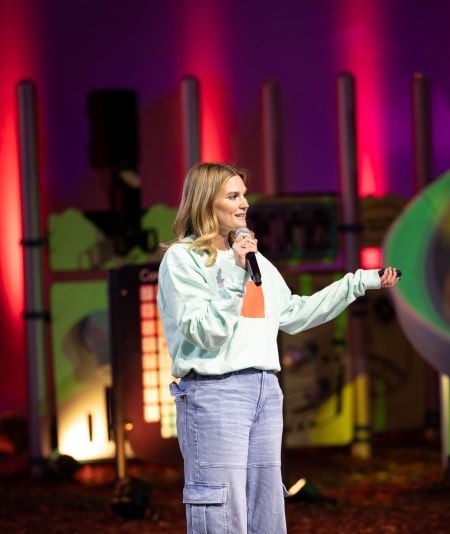 Dr. Ariel Mansholt brings both personal passion and clinical expertise to inclusive play. She was inspired to become an occupational therapist after growing up with an autistic brother and seeing how thoughtful environments can shape a child’s ability to connect, grow and thrive through play.
Clinical Focus
- Practicing pediatric and adolescent occupational therapist serving children and young adults ages 18 months to 21 years
- Works in both outpatient and school settings, supporting students PreK–8 and serving on IEP teams
- Partners with families, teachers and school staff to help skills transfer from therapy and classrooms into everyday life and play
Education & Landscape Structures Work
- Earned her doctorate from Baylor University in 2022
- Completed her doctoral capstone with Landscape Structures, exploring how pediatric conditions impact a child’s ability to play
- Supports inclusive design and education for designers, sales teams and communities
- Presenter at state and national conferences including National Recreation & Park Association, American Society of Landscape Architects and California Park & Recreation Society
Research & Mentorship
- Contributes to research on play behaviors and inclusive playground design
- Recognized in 2025 with Baylor University’s Outstanding Capstone Mentor Award
At the heart of Ariel’s work is a simple belief: when play is designed for everyone, it helps every child feel seen, supported and included.
References for The Many Ways We Play
Atchison, B. (2017). Conditions in occupational therapy: effect on occupational performance (5th ed.). Philadelphia: Wolters Kluwer Publishing Co.
Barnes, G., Wilkes-Gillan, S., Bundy, A., & Cordier, R. (2017). The social play, social skills, and parent – child relationships of children with ADHD 12 months following a RCT of a play – based intervention. Australian Occupational Therapy Journal, 64, 457-465. doi: 10.1111/1440-1630.12417
Batshaw, M. (Ed.). (2019). Children with disabilities (8th ed.). Baltimore: Paul H. Brookes Publishing Co.
Bobzien, J., Richels, C., Raver, S., Hester, P., Browning, E., Morin, L. (2013). An observational study of social communication skills in eight preschoolers with and without hearing loss during cooperative play. The Early Childhood Education Journal, 41. 339 – 346. doi: 10.1007/s10643-012-0561-6
NCBDDD. (2022). Developmental milestone. Centers for Disease Control and Prevention. https://www.cdc.gov/act-early/milestones/index.html
Chiarello, L., Bartlett, D., Palisano, R., McCoy, S., Jeffries, L., Fiss, A., & Wilk, P. Determinants of playfulness of young children with cerebral palsy. Developmental Neurorehabilitation, 22, 4. 240 – 249. https://doi.org/10.1080/17518423.2018.1471623
Doctoroff, S. (2001). Adapting the physical environment to meet the needs of all young children for play. Early Childhood Education Journal. 29 (2).
Goldstein, J. (2012). Play in children’s development, health and well-being. Brussels: Toy Industries Europe.
Graham, N., Mandy, A., Clarke, C., & Morriss-Roberts, C. (2019). Play experiences of children with a high level of physical disability. American Journal of Occupational Therapy, 73, 7306205010. https://doi.org/10.5014/ajot.2019.032516
Holmes, Kat. (2018). Mismatch: How inclusion shapes design. The MIT Press.
Messier, J., Ferland, F., & Majnemer, A. (2008). Play behavior of school age children with intellectual disability: Their capacities, interests, and attitude. The Journal of Developmental and Physical Disabilities, 20. 193 – 207. doi: 10.1007/s10882-007-9089-x
Miller, L. (2014). Sensational Kids: Hope and help for children with sensory processing disorder (SPD) (Revised Edition). New York: Penguin Group (USA) LLC.
Neudecker, C., Mewes, N., Reimers, A., Woll, A. (2019). Exercise interventions in children and adolescents with ADHD: A systematic review. Journal of Attention Disorders, 23 (4). 307 – 324. doi: 10.1177/1087054715584053
Nijihof, S., Vinkers, C., van Feelen, S., Duijiff, S. et al. (2018). Health play, better coping: The importance of play for the development of children in health and disease. Neuroscience and Biobehavioral Reviews, 95, 421 - 429. doi: https://doi.org/10.1016/j.neubiorev.2018.09.024
O’Brien, J. & Kuhaneck, H. (2020). Case-Smith’s occupational therapy for children and adolescents (8th ed.). Elsevier.
Pochon, R.; Touchet, C.; Ibernon, L. (2022) Recognition of basic emotions with and without the use of emotional vocabulary by adolescents with down syndrome. Behavioral Sciences, 12,167. https:// doi.org/10.3390/bs12060167
Rodriguez – Grande, E., Vargas – Pinilla, O., Torres – Narvaez, M., & Rodriguez – Malagon, N. (2022). Neuromuscular exercise in children with down syndrome: A systematic review. Scientific Reports. https://doi.org/10.1038/s41598-022-19086-8
Sonday, A. & Gretschel, P. (2015). Empowered to play: A case study describing the impact of powered mobility on exploratory play of disabled children. Occupational Therapy International, 23, 11 - 18. doi: 10.1002/oti.1395
van Engelen, L., Ebbers, M., Boozaajier, E., van der Put, E., & Bloemen, M. (2021). Barriers, facilitators and solutions for active inclusive play for children with a physical disability in the Netherlands: a qualitative study. BMC Pediatrics, 21: 369. https://doi.org/10.1186/s12887-021-02827-5
Vietch, J., Ball, K., Rivera, E., Loh, V., Deforche, B., & Timperio, A. (2021). Understanding children’s preference for park features that encourage physical activity: An adaptive choice based conjoint analysis. International Journal of Behavioral Nutrition and Physical Activity 18:133. doi: https://doi.org/10.1186/s12966-021-01203-x
Watts, T., Stagnitti, K., & Brown, T. (2014). Relationship between play and sensory processing: A systematic review. American Journal of Occupational Therapy, 68, e37–e46. http://dx.doi.org/10.5014/ajot.2014.009787
Wenger, I., Schulze, C., Lundström, U., & Prellwitz, M. (2021). Children’s perceptions of playing on inclusive playgrounds: A qualitative study, Scandinavian Journal of Occupational Therapy, 28:2, 136-146, DOI: 10.1080/11038128.2020.1810768
Whittingham, K., Fahey, M., Rawicki, B., & Boyd, R. (2010). The relationship between motor abilities and early social development in a preschool cohort of children with cerebral palsy. Research in Developmental Disabilities, 31, 1346–1351. https://doi.org/10.1016/j.ridd.2010.07.006
World Health Organization (2009). Global Health Risks: Mortality and Burden of Disease Attributable to Selected Major Risks. Geneva: Author.
Xiang, S., Dong, J., Li, X., & Li, L. (2021). Association between sleep duration, physical activity, and mental health disorders: A secondary analysis of the national survey of children’s health 2017 – 2018. BioMed Research International. https://doi.org/10.1155/2021/5585678
 Oops! The Internet Explorer (IE) browser is no longer supported.