Delivering natural play at the EPCOT® International Flower & Garden Festival

2018 EPCOT® International Flower & Garden Festival

We are excited to have our playground equipment featured at the 25th Annual EPCOT® International Flower & Garden Festival. The upcoming holiday weekend is the final one of the Festival. So if you’re near or planning a visit to Lake Buena Vista, Fla., be sure to go play at EPCOT.

New to the Festival this year is the Imagination Garden, which integrates play into the natural environment. Nestled among the flowers, trees and other landscaping elements is a maze of play. Kids of all ages can navigate the playground tunnels to discover fossil digs and Rhapsody® Outdoor Musical Instruments. Upon finding their way out of the maze, kids ages 2 to 5 find more playground fun with the hillscape climber, pod steppers and leaf panels while kids ages 5 to 12 can traverse their way up and around the Lunar Burst® Net Climber. The play space design truly plays off the aesthetics of the surrounding landscape design.

Get more information about the Landscape Structures playground equipment featured at the EPCOT International Flower & Garden Festival. Then see how you can design nature-inspired playgrounds for your community or school playground at playlsi.com.

Spreading global awareness about Sensory Processing Disorder

STAR Institute for Sensory Processing Disorder

October is Sensory Awareness Month, and we’re already focusing on next month because we want to help spread global awareness about this disorder.

On Oct. 6-7, our partners at the STAR Institute for Sensory Processing Disorder will host their 20th Annual International 3S Symposium in Denver, Colo. The Symposium will highlight 20 years of research accomplishments with though-provoking research and strategy presentations by clinical experts.

The Symposium is great for any individuals–occupational or physical therapists, special education teachers, early intervention specialists, parents and more–seeking a better understanding of Sensory Processing Disorder. And in addition to the two-day Symposium, the STAR Institute is hosting a pre-symposium workshop for parents focused on relationships and SPD across the lifespan.

Learn more and register for the 3S Symposium and pre-symposium workshop here. And watch our short video below to learn more about the history of the STAR Institute.

How playground spinners help develop kids’ senses

omnispin_blog

OmniSpin® spinner

What are your kids’ favorite playground activities? Modern day merry-go-rounds and playground swings tend to attract droves of kids. So why are kids fascinated with swinging and spinning activities? Because it’s one of the core movements that engages the vestibular system. When a child spins on spinners like the OmniSpin® spinner or Saddle Spinners their brain receives signals to help control movement and balance. Even more, our playground spinners are not only fun, but they also deliver opportunities for social and cooperative play.

Children discover their world and how to be successful in it through sensory play. They develop their behaviors based on what they learn through their senses. And the more sensory-rich play experiences they have, the more they develop skills necessary to engage, change and impact the world around them. Learn more at playlsi.com, and tell us below what playground activity your kids like best.

Creating more excitement with playground colors

When it comes to playgrounds, color is just as important to a child’s learning environment as the play structure itself. To create a sensory-rich playground environment for children, we spent the past year researching outdoor environments and working with chemists to create color formulas in nature-inspired hues and tones. The new colors—Berry, Buttercup, Carbon, Grass, Lagoon, Paprika, Peacock and Sky—are designed to enhance a child’s play experience.

Nature-inspired playground colors

The benefits of these innovative colors are numerous:

  • Nature-inspired colors allow children to engage in a playground design that creates a calming experience. This is because tones that reflect the outdoors are familiar to children. For example, we wanted the tone Buttercup to relay the feeling of playing a field of flowers.
  • Unlike the average toy, which is meant to drive visually loud experiences, natured-inspired playground colors help children focus. This is particularly beneficial for children with sensory processing disorders who often seek soothing environments, and the tones Sky and Peacock are meant to replicate the calming sense of sky gazing or playing in a garden.
  • Our new color line intentionally adds a metallic fleck to a matte finish for a richer finish that creates texture and offers a tactile play experience.

Harry Thomas Sr. Playspace

Learn more about our color inspirations and our overall design philosophy at playlsi.com. And tell us here how you use color to create additional dimension in your designs.

Supporting inclusive play

Last week, we were honored at the Sensory Processing Disorder (SPD) Foundation’s 1st Annual Banquet of Champions. Held at the Inverness Hotel and Conference Center in Englewood, Colo., the event brought together people to help raise funds for research towards understanding behavioral and brain differences in children with SPD. Additionally, the Foundation celebrated individuals and organizations that have supported the SPD Foundation.

Proud to be recognized by the SPD Foundation for our commitment to inclusive play.

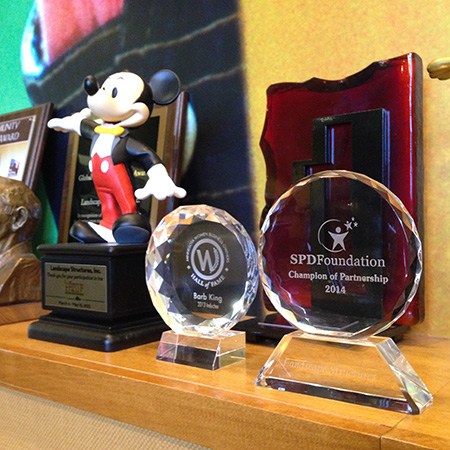
We were presented the Champion of Partnership award for partnering with the SPD Foundation to bring “The World’s Best Sensory Playground” to the STAR Center. The inclusive and sensory-stimulating playground equipment is used as a therapy tool for kids receiving treatment at the STAR Center.

Dr. Miller created an inclusive playground with many sensory-rich activities at the STAR Center.

We’re proud to work with the SPD Foundation and support their research in sensory processing disorders, and honored by this recognition. Learn more about the SPD Foundation and the STAR Center, and go here to read more about our commitment to inclusive play.

Bringing play to schools around the nation

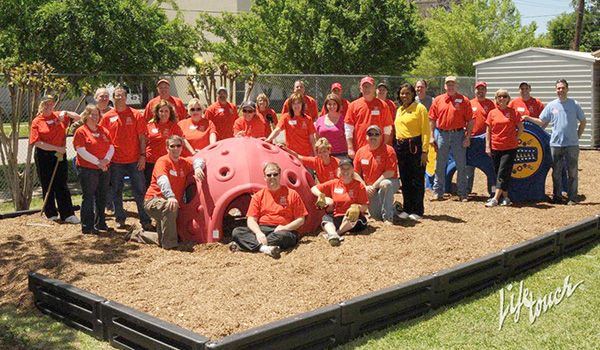
We’re honored to partner with the National Association of Elementary School Principals (NAESP) on their Community Service Day. For the past four years, we’ve worked side-by-side with principals from around the nation to build and beautify school playgrounds in conjunction with the organization’s annual conference.

John Ruhrah Elementary/Middle School, Baltimore, Md.

John Ruhrah Elementary/Middle School, Baltimore, Md.

In July, we worked with NAESP members to install an inclusive playground at John Ruhrah Elementary/Middle School in Baltimore, Md. Principal Mary C. Donnelly said that she thinks the new playground will dramatically increase the use of outdoor grounds for both school instruction as well as recreation. As we completed the playground project with NAESP this year, we thought it would be fun to look back at the other schools we’ve helped over the years.

Hawthorne Elementary School, Seattle, Wash.

Hawthorne Elementary School, Seattle, Wash.

Principals congregated at Seattle’s Hawthorne Elementary School in March 2012 to build an inclusive playground. In just a few hours, the inclusive PlayBooster® playstructure was installed, allowing the principals to network with each other and interact with Hawthorne Elementary students.

Booker T. Washington Elementary School, Tampa, Fla.

Booker T. Washington Elementary School, Tampa, Fla.

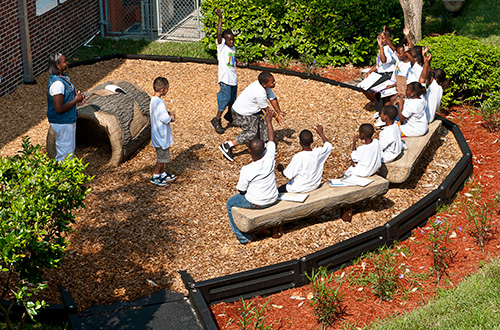
In April 2011, we created a nature-inspired outdoor learning environment for Booker T. Washington Elementary School in Tampa, Fla. Now more than two years later, Principal Toynita Martinez says the outdoor classroom concept is being embraced. “All of our teachers are taking advantage of the outdoor classroom,” said Martinez. “A lot of math and science classes take place outside. Plus, reading groups disperse in the space to finish a reading assignment and then come together to discuss.”

MacGregor Music and Science Academy, Houston, Texas

MacGregor Music and Science Academy, Houston, Texas

Our first time participating in the NAESP Community Service Day was in 2010. We designed a sensory-rich play space complete with the Sensory Play Center® and Cozy Dome® for students at MacGregor Music and Science Academy in Houston, Texas. “We’re really proud and still excited about the gift that NAESP and Landscape Structures provided,” said Principal Patricia Allen of the playground.

Learn more about our partnership with NAESP, and our joint commitment to enhancing the lives of children and the communities in which they live.

Meet the professional: Dr. Lucy Jane Miller

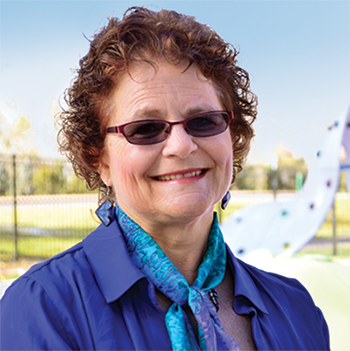
Dr. Lucy Jane Miller, founder of the SPD Foundation and STAR CenterWe are so honored to work with clients around the world, and we’re constantly learning about their fun and unique projects, obstacles they’ve faced and the innovative solutions they’ve created to overcome challenges. That’s why we’ve created this new feature that spotlights professionals. This week, meet Dr. Lucy Jane Miller, founder of the Sensory Processing Disorder (SPD) Foundation and the STAR Center. Below, you’ll learn how she came to begin her career, and what lead her to start the SPD Foundation.

When I was 16-years-old, I stopped seeing things the way other people do. Literally.

Without contact lenses in my eyes, objects were growing blurrier and blurrier. With contacts in, I could see but my eyes ached until, after several hours, I could hardly bear the pain. Only a few months earlier, I’d been thinking about where to go to college, what to do for the summer and all the other things typical 16-year-old girls think about. Then this one big sensory piece started to fail—my sense of sight—and my whole world shifted. My parents took me to a local ophthalmologist but he brushed aside my complaints. “There’s nothing the matter with her eyes,” he told us. “It’s all in her head.”

I was in college before we solved the mystery of my fading vision. By then, wearing contact lenses for more than a few minutes had become agony and even enormous shapes were fuzzy without them. It was my alarmed freshman roommate who insisted I see a doctor at the school clinic, triggering a series of referrals that finally brought answers and help. I was diagnosed with advanced keratoconus, a disease that distorts the corneas and—without treatment—eventually, leads to blindness.

The diagnosis was grave but it also came as a relief. My vision problems weren’t all in my head after all! The symptoms were real and they had a name. I finally knew what I was fighting and could make a plan for fighting it.

The year was 1971 and the cure for the disease was corneal transplants in both eyes, a procedure only two doctors in the U.S. were qualified to perform. I went on a waiting list for donor corneas, doubling up on classes so I could finish college before my surgery, learning Braille and practicing with a white cane, just in case the cure didn’t work and I lost what was left of my eyesight. A few weeks before graduation, I reached the top of the list for my first transplant. During the two-hour surgery, the old bad right cornea was removed and a new donated cornea was stitched to my eyeball with 16 sutures that would jab my eye and eyelid like teensy relentless needles for the three months after surgery when both my eyes had to be patched.

The operation was a total success, but I felt lost in my carefully maintained darkness. The endless stream of doctors, fellows, residents and medical students who gazed admiringly at my eye murmured, “beautiful, beautiful,” but I didn’t feel beautiful at all. I couldn’t see. I made a mess when I tried to eat. I couldn’t perform basic personal hygiene tasks and, after a lifetime seeing people when I talked, it didn’t feel like communication when I talked in the dark. What’s more, the admiring medical people who visited seemed to care only about my beautiful new eye. I felt reduced to a single sensory organ—an eyeball.

Then a new person entered my life. She was a young occupational therapy student doing her internship and she had been assigned to teach me how to feed, dress and take care of myself. She was about my age and showed no interest in my eyeball at all. Instead, she talked to me, Lucy Jane Miller, and listened to what I said. She always wanted to know how I—not my eye—was doing and she told me little things about her life so we had a real relationship even though I couldn’t see her. I silently called her “Angel” and imagined her with long blonde hair, blue eyes, a perfect Olympian body, and a halo, of course. I learned to identify her footsteps and detect her scent so I could say, “Hi, Angel!” just as she came into my room.

Then came the day when Angel chanced into the room when my patches were being changed and I finally glimpsed my rescuer with my eyes as well as with my other senses. The sight astonished me. Angel was a polio survivor. Half her face and body had been paralyzed and left sagging by the disease. In my darkness, Angel was beautiful because I could only “see” the beauty that was inside.

In the fog of recuperation, my future came into focus. While still in my eye patches, I applied to occupational therapy school. Two days after the last stitches were removed following my second transplant, I started graduate school.

One of the first books I read with my new good eyes was the work of a pioneering occupational therapist and neuroscientist named A. Jean Ayres. In Sensory Integration and Learning Disabilities, Dr. Ayres wrote in detail about the behavioral, social and emotional issues that arise when a child’s sensory foundation is not firmly established early in life. She stressed the importance of early diagnosis of sensory disorders and described in detail how occupational therapy (OT) could and was helping children. Fresh as I was from my own darkness, Dr. Ayres’ words resonated instantly.

Demoralized and disabled by the long-term repercussions of a doctor’s proclamation that my symptoms were all in my head, I knew how critical accurate and early diagnosis was. Barely out of my teens, I had known the humiliation of being unable to perform normal, everyday routines like other people my age. Grateful for Angel’s care, I was a firm believer in how dramatically OT could address sensory issues and improve a person’s life. Before first semester ended, I decided to spend my life promoting the understanding, accurate diagnosis and effective treatment of the sensory-based disorders that Dr. Ayres described.

From Sensational Kids: Hope and Help for Children with Sensory Processing Disorder (SPD)

Learn more about Dr. Miller and the research, education and treatment she provides to help individuals struggling with SPD. Then read about our partnership with the SPD Foundation and the STAR Center, including its sensory playground.

Dr. Miller created an inclusive playground with many sensory-rich activities at the STAR Center.

New playground welcomes all, supports recovery

Sullivan Playgroud at University of Minnesota Amplatz Children's Hospital features an inclusive design.

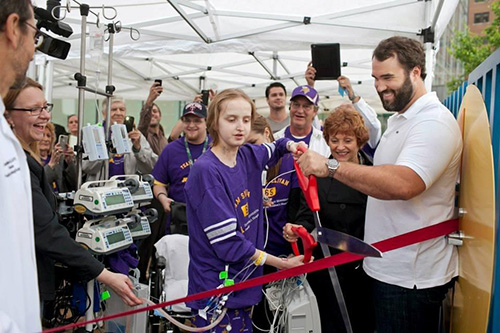
Last week, we celebrated the grand opening of Sullivan Playground at University of Minnesota Amplatz Children’s Hospital. The playground is named for Minnesota Vikings Center John Sullivan, who pledged $150,000 to create the play space. Vikings teammate Chad Greenway, through his Lead the Way Foundation, and the Minnesota Vikings football organization also committed $25,000 each to bring the project to fruition.

Vikings Center John Sullivan welcomes patients and their siblings to the inclusive playground at University of Minnesota Amplatz Children's Hospital.

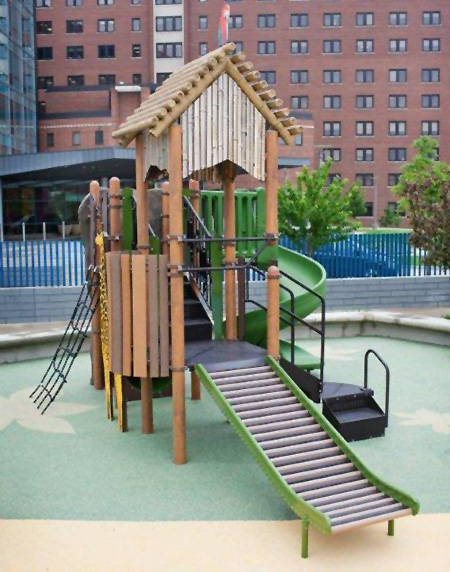
Sullivan Playground is a safe and accessible playground for patients and their siblings to play while they’re visiting the hospital. The playground features a large concrete elephant, a concrete manta ray bench, a Permalene® giraffe panel, nature-inspired roofs and PebbleFlex® safety surfacing with custom graphics including John’s signature. Even more than the unique visual aspects, the playground’s design features take into account the patients who will use the equipment.

Children with IVs can use the Rollerslide without worrying about getting tangled in the posts.

The Rollerslide was customized to accommodate children with IVs.

Following are just a few of the inclusive components incorporated into Sullivan Playground:

  • Because some children at Amplatz must be hooked up to IVs constantly, the playground features a custom Rollerslide that allows kids to climb up and slide down without getting tangled in the equipment. This is the first commercial outdoor slide ever made to accommodate children with IVs.
  • Swaying benches provide a place for parents and children to relax and take in the fresh air.
  • A climbing net gives patients’ siblings a place to blow off steam while they develop their large motor skills.
  • A Talk Tube located in the elephant’s trunk allows kids on the ground to communicate with friends on the structure’s upper deck.
  • A shade structure provides protection for kids whose treatments make them sensitive to the sun.
  • Children using walkers or wheelchairs can navigate the playground with ease on this cushioned, porous surface.

Ribbon-cutting ceremony for Sullivan Playground at University of Minnesota Amplatz Children's Hospital.

The grand opening celebration included a ribbon-cutting ceremony featuring a special patient and his family. Immediately following the ceremony patients and families were able to test out the new playground.

Thornton Creek Elementary School celebrates new inclusive playground

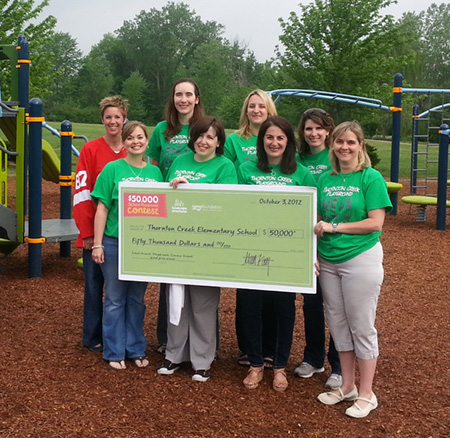
The grand prize recipient of the School Grounds. Playgrounds. Common Ground.® contest, Thornton Creek Elementary School in Novi, Mich., celebrated the completion of their new inclusive playground with a grand opening on Thursday, May 23. The school received $50,000 in inclusive playground equipment from the Landscape Structures- and NAESP Foundation-sponsored contest, plus a playground committee spearheaded some major fundraising efforts in order to design a truly inclusive playground for students.

Thornton Creek's playground committee worked tirelessly to raise additional funds.

Thornton Creek Elementary School playground committee

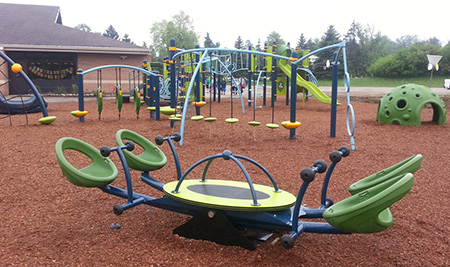
Thornton Creek Elementary School’s new playground features an inclusive design that focuses on bringing children of all abilities together to learn, play and grow. A PlayBooster® playstructure was included in the design along with inclusive and sensory-focused freestanding components like the Cozy Dome®, OmniSpin® spinner, Oodle® Swing and We-saw™. Thornton Creek Elementary School’s new playground will welcome children of all abilities as well as serve as an outdoor classroom to help students develop their social, problem solving and gross motor skills.

The We-saw™ is just one of the inclusive playground components at Thornton Creek's new inclusive playground.

Thornton Creek Elementary School’s new inclusive playground

The grand opening included a ribbon-cutting ceremony with all of the students. Classrooms that raised the top fundraising dollars were honored and allowed the “first play” opportunity on the new playground followed by other classrooms throughout the morning. Congratulations to the entire school community for providing a place where kids of all abilities can play together!

Celebrating National Sensory Awareness Month with a Playground Grand Opening

October is National Sensory Awareness Month. The month helps raise awareness about sensory processing disorders (SPD) as well as funds to support research, education and advocacy. Sensory processing disorder, a condition that exists when sensory signals don’t get organized into appropriate responses, affects 5 to 10 percent of all children.

STAR Center sensory playground grand opening

To kick off National Sensory Awareness Month, we celebrated the grand opening of the STAR (Sensory Therapies and Research) Center’s state-of-the-art sensory playground. The event welcomed nearly 300 people from Greenwood Village, Colo., and surrounding communities. Many of the children and families in attendance were clients of the STAR Center, who were excited to see the playground in action.
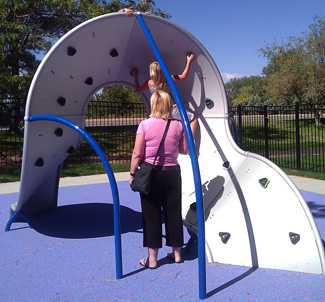
Mobius® Climber

Mobius® Climber

While creating the design for the STAR Center’s playground, which will be used as a therapy tool to treat children with SPD, our designers took into account the different sensory needs of the children who will use the equipment. A variety of components included offer something for all kids experiencing sensory processing disorders:

  • The Mobius® Climber provides tactile, proprioceptive and vestibular stimulation.
  • OmniSpin® spinners, in addition to vestibular stimulation, encourage cooperative play to maximize social interaction.
  • The Cozy Dome® offers a quiet space for over-stimulated kids to calm down and re-center themselves, or engage in imaginative play.
  • Social imaginative play from the Sensory Play Center® lets children integrate previous sensory knowledge with new experiences to expand their understanding of the world.
  • Children survey their world from the high vista of the PlayBooster® Tree House, inspiring them to stretch their horizons.
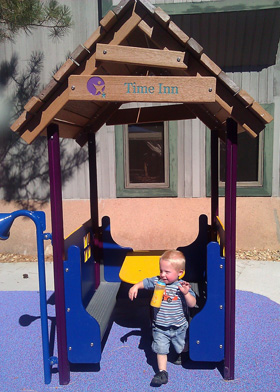
Time Inn

Time Inn, when kids choose to go in, it is their quiet time and nobody can ask them to come out for any reason.

The STAR Center and its sister organization, the Sensory Processing Disorder Foundation, offer services and programs for professionals parents, and anyone interested in knowing more about the sensory challenges that affect children. Learn more here.