Avoid the bid process with cooperative purchasing contracts

Purchasing commercial playground equipment through the bid process can add extra work and delays in developing and installing your new play space. The bid process also sometimes forces you to settle for less than expected if you’re forced to accept the low-bid, lower-quality alternative to your specifications. That’s why we offer our customers the option to purchase our park and playground equipment using national cooperative purchasing contracts.

We have a variety of purchasing contracts from which to choose including HGACBuy, TCPN, NPCA for cities, school districts and other municipal entities. All of these contracts are nationwide government-procurement services that establish competitively priced contracts for goods and services with the assurance that all contracts have been awarded through a competitive, public bidding process that is compliant with your state bidding statutes. Following are just a few of the benefits of using cooperative bidding contracts:

  1. You can avoid the bid process, and expenses incurred, while meeting state or local purchasing guidelines.
  2. You save money through product discounts; the contracts establish and verify best pricing offered nationally by a supplier.
  3. You keep complete control of the quality, design and manufacturer of your next playground purchase.

Any tax-based agency or non-profit 501c3 is eligible to use cooperative purchasing contracts. Contact your local playground consultant to learn more, and get set-up to replace the traditional in-house bid process with the easy-to-use, no-cost services provided by cooperative purchasing contracts.

Guest Blog: Building social bridges at NAEYC

This post comes to you from Marnie Norris, director of programs at Shane’s Inspiration. Earlier this month, she presented at the 2012 National Association for the Education of Young Children (NAEYC) Conference. Marnie’s session, titled Together, We Play! discussed how to use play-based techniques, including peer buddies, to integrate children with and without disabilities, support children with sensory and communication differences, and minimize conflict opportunities. Read below for ideas she shared as well as took away from the discussion.

At a major conference with thousands of attendees and a wide variety of sessions to choose from, you always wonder how needed your information is…how much is social inclusion on the minds of early childhood educators?

As the room filled up two weeks ago in Atlanta, it was clear that teachers, principals, and professionals need tools to support the social interaction between students with and without disabilities…interaction that can happen spontaneously in early childhood but not always consistently.

Here are few tips and tools that we shared with each other during our workshop:

1. Start ability awareness early…in Kindergarten, a book and guided discussion, followed up by consistent interaction through play, is enough (We Can Do It! By Laura Dwight, Susan Laughs by Jeanne Willis). At that age, we focus on the fact that everyone has a hard to and a can do. For some, the hard to may be walking or for others talking. Help the students to connect their can dos and hard tos! Together, we can do.

2. Turning the challenge into the tool…if you have a student unable to connect through play find out what he/she is focusing on (ex: my student does nothing but spin the wheels on the train…find a peer who loves playing with trains. Let the peer hold the train while his buddy spins the wheels as a start. Give them time away from the group and excess stimuli to explore trains together.)

3. Flexibility in group activities…if you have a student interested in but unable to interact with the group, isolate one or two of her peers and let them play as a small group. Once the connection is made with a smaller number of children consistently, she may be more drawn in to circle time/group play.

4. Grouping the students…if you have a few students with disabilities in your classroom, create play groups consisting of two or three students with typical abilities and a student with disabilities. Give the groups identities: Bears, Penguins, Butterflies. Let them use the playground or indoor space as a group to encourage social interaction in smaller numbers.

5. Sensory stimulation…many teachers spoke about students having tantrums/outbursts because of being over stimulated. Find out what your student’s sensory profile is: is he triggered by sound (if so, is it specific or the wall of noise), touch (too much light touch, too little deep pressure on their bodies), light/color, etc. If you can, have Mom and Dad share what triggers him at home. Then you can modify his environment to support the sensory needs: some students are under-sensitive to touch and need bigger movements, deeper hugs or weighted jackets to help them register the sensation.

Most importantly…keep trying! Creating awareness and understanding in students (and adults) as to how our peers who have differences communicate, feel and socialize will help everyone. Combine consistent play with that awareness and you have a powerful foundation for social bridges!

Create inspiring play spaces together

If you’re working on an upcoming playground project, be sure to check out our 2013 Design Book for inspiration. The book features seven playgrounds from across the country that incorporate a theme, learning opportunities for visitors and truly innovative design.

Sunset Park, Las Vegas, Nev.
Clark County Nevada, Parks & Recreation Department

We have decades of custom design experience, and can help you create a playground design that best fits your community’s personality. Our team of custom designers and artists has created everything from boats and ships to aliens and UFOs, as well as unique designs without themes that become playable art.

Indian Creek Playground, Berwyn Heights, Md.
The Maryland National Capital Park and Planning Commission, Prince George’s County Department of Parks and Recreation

Whatever your idea, we’ll help you bring it to life on the playground. Kids’ imaginations with soar with a custom and theme playground design. Get your creative juices flowing… browse our 2013 Design Book, or request that a copy be mailed to you here.

Celebrating National Sensory Awareness Month with a Playground Grand Opening

October is National Sensory Awareness Month. The month helps raise awareness about sensory processing disorders (SPD) as well as funds to support research, education and advocacy. Sensory processing disorder, a condition that exists when sensory signals don’t get organized into appropriate responses, affects 5 to 10 percent of all children.

STAR Center sensory playground grand opening

To kick off National Sensory Awareness Month, we celebrated the grand opening of the STAR (Sensory Therapies and Research) Center’s state-of-the-art sensory playground. The event welcomed nearly 300 people from Greenwood Village, Colo., and surrounding communities. Many of the children and families in attendance were clients of the STAR Center, who were excited to see the playground in action.

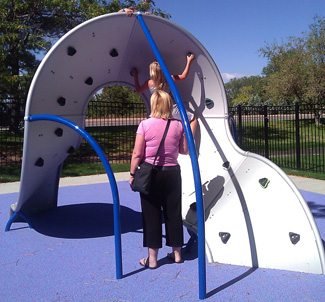
Mobius® Climber

Mobius® Climber

While creating the design for the STAR Center’s playground, which will be used as a therapy tool to treat children with SPD, our designers took into account the different sensory needs of the children who will use the equipment. A variety of components included offer something for all kids experiencing sensory processing disorders:

  • The Mobius® Climber provides tactile, proprioceptive and vestibular stimulation.
  • OmniSpin® spinners, in addition to vestibular stimulation, encourage cooperative play to maximize social interaction.
  • The Cozy Dome® offers a quiet space for over-stimulated kids to calm down and re-center themselves, or engage in imaginative play.
  • Social imaginative play from the Sensory Play Center® lets children integrate previous sensory knowledge with new experiences to expand their understanding of the world.
  • Children survey their world from the high vista of the PlayBooster® Tree House, inspiring them to stretch their horizons.
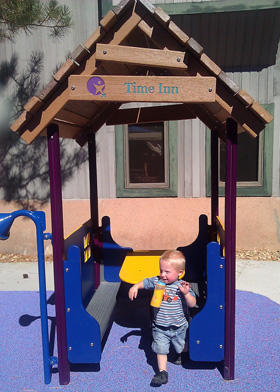
Time Inn

Time Inn, when kids choose to go in, it is their quiet time and nobody can ask them to come out for any reason.

The STAR Center and its sister organization, the Sensory Processing Disorder Foundation, offer services and programs for professionals parents, and anyone interested in knowing more about the sensory challenges that affect children. Learn more here.

Designed to… Innovate and Strengthen at NRPA 2012

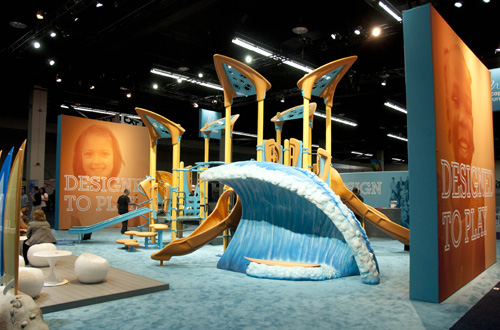
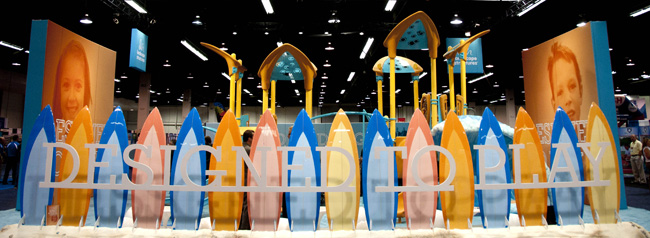
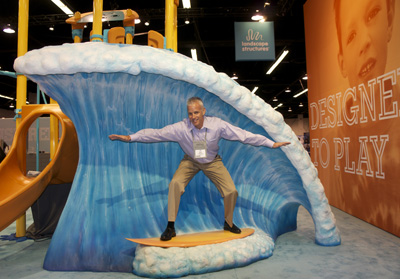
Last week, we were in Anaheim, Calif., to participate in the 2012 National Recreation & Park Association (NRPA) Congress & Exposition. We exhibited with a beach-themed booth design, which featured the PlayBooster® Vibe™ and a 6-foot ocean wave sculpted from concrete.

NRPA beach-themed booth design

Visitors to our booth got a chance to meet some of our custom designers and artists, as well as participate in mock design sessions. Attendees were encourages to put their creativity to work to create a personalized t-shirt. See photos of inspiring t-shirts on Facebook, and tell us what you’re “designed to” do.

Designed to Play

On Wednesday, Oct. 17, we hosted a reception on the 5th Floor Lanai at the Hilton Hotel Anaheim. It was a gorgeous evening in a gorgeous space, and we welcomed more than 400 people to the event. In addition to cocktails, hors d’oeuvres and fun, we also celebrated the NRPA Award Winners including the recipient of the Barb King Award for Environmental Stewardship—the County of San Diego, Department of Parks and Recreation. The award was created for Barb King (1946-2008), who cofounded Landscape Structures with her husband, Steve King, to honor her passion for environmental stewardship and sustainability.

Hit the waves

We had a great three days in Anaheim visiting with park and recreation professionals, hearing from industry experts and taking in the nearby attractions. Our employees and playground consultants are already looking forward to 2013 NRPA in Houston, Texas!

School in Novi, Mich., awarded $50,000 in inclusive playground equipment

Thornton Creek Elementary School in Novi, Mich., is the grand prize winner of the School Grounds. Playgrounds. Common Ground.™ essay contest.

We’re proud to announce that Thornton Creek Elementary School in Novi, Mich., was named the grand prize winner of the School Grounds. Playgrounds. Common Ground.™ essay contest! The school was awarded $50,000 in inclusive playground equipment from Landscape Structures to help them expand the inclusivity of the school environment to the playground.

Thornton Creek Elementary School has a mission to share the responsibility of creating a safe and positive environment that promotes self-esteem, mutual respect and optimum student learning, and each member of the school community is taught and understands that everyone learns at different rates, times and through different strategies. Because Thornton Creek takes students’ learning opportunities from the classroom to the playground, they realized that it, too, needed to be more inclusive to welcome the diverse population.

Runners-up were awarded $15,000 each in inclusive playground equipment from Landscape Structures. Runners-up included:

  • Utsalady Elementary School in Camano Island, Wash.
  • Lone Dell Elementary in Arnold, Mo.
  • Clyde F. Brown Elementary School in Millis, Mass.
  • James Whiteside Elementary in Richmond, British Columbia

The school playground contest was sponsored by Landscape Structures in partnership with the National Association of Elementary School Principals (NAESP) Foundation in an effort to bring inclusive playground environments to schools across North America. The NAESP Foundation is the philanthropic arm of the National Association of Elementary School Principals, a professional organization serving elementary and middle school principals and other education leaders throughout the U.S., Canada and overseas.

Custom design creates destination playground

Sibley Park, Mankato, Minn.

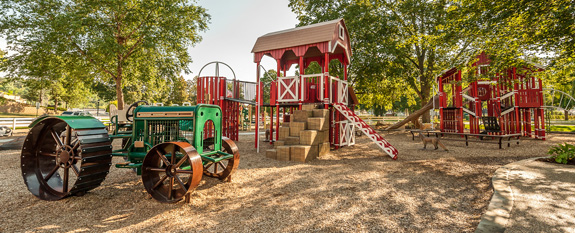
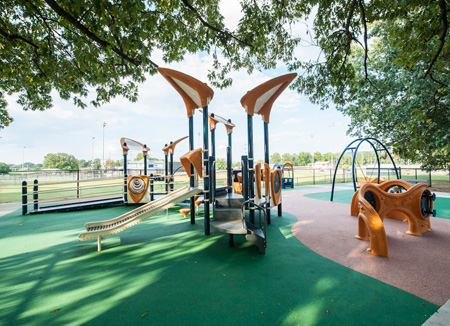
Sibley Park in Mankato, Minn., recently opened its new farmstead-themed playground. The playground is installed next to Sibley Farm, a petting zoo complete with alpacas, calves, goats, peacocks, horses, pigs, lambs, chicks and ducklings, and the playground structures match the red barn-style buildings of the zoo.

Our local playground consultant, Flagship Recreation, and our custom design team at Landscape Structures collaborated with the client to create a one-of-a-kind play area. Using a variety of materials, they created two barn-themed playstructures, a chicken coop structure, pig pen, tractor climber, corn stalk climbers, a wagon-themed seesaw and much more. What makes the playground come alive are the farm animals—chickens, coyotes, horses and pigs—sculpted from concrete and hand painted by our team of artists.

The new farmstead-themed playground has quickly become a destination play space for communities surrounding Mankato. Kids and families visit the playground regularly to explore and play. Check out the below video of the playground in action, then see if for yourself at 900 Mound Avenue in Mankato.

[youtube=http://youtu.be/MgKXiWm-XIg]

Miracle League of North Alabama celebrates complex opening

Last month, the Miracle League of North Alabama, located in Huntsville, celebrated the grand opening of its baseball complex at Braham Spring Park. The accessible baseball field is now ready for the 165 kids and adults with special needs who are signed up to play baseball this fall, plus the complex includes a truly inclusive playground and a one-of-a-kind concrete statue of Homer, the Miracle League’s mascot.

Miracle League logo in the PebbleFlex® baseball field.

Miracle League logo in PebbleFlex® surfacing.

The grand opening event welcomed nearly 200 people from Huntsville and surrounding communities. People in attendance learned about the history of The Miracle League Association, the national organization that designs and constructs custom baseball fields for children with mental and/or physical challenges, from Executive Director Diane Alford. Additionally, the mayor of Huntsville, named and dedicated the field Johnny Franklin Field, after Johnny Franklin, North Alabama’s league director, the league developer for the national office and the driving force behind the project in Huntsville.

Inclusive PlayBooster® Vibe™ play structure with PebbleFlex safety surfacing.

Inclusive PlayBooster® Vibe™ play structure with PebbleFlex safety surfacing.

We’re proud to say that we were involved in each main component of the baseball complex. The accessible baseball field was created using PebbleFlex® safety surfacing, which features custom color blends and graphics including the Miracle League logo. The inclusive playground features a PlayBooster® Vibe™ playstructure, and uses a variety of multi-sensory playground components like the Rollerslide, Cozy Dome®, OmniSpin® spinner and Oodle Swing®.

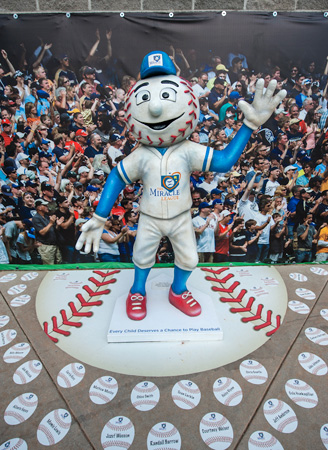
Homer, the Miracle League mascot, was custom designed out of concrete and hand-painted by Landscape Structures' artists.

The Miracle League mascot, Homer, constructed of concrete.

Unique to the Miracle League of North Alabama’s complex is the concrete statue of Homer. The statue, constructed of Glass Fiber Reinforced Concrete (GFRC), is completely custom designed and was hand-painted by Landscape Structures’ artists. Homer is positioned behind home plate, and provides a distinctive photo opportunity for visitors to the baseball complex.

Designing beyond the boundaries at ASLA 2012

Next weekend, we will be in Phoenix, Ariz., for the 2012 American Society of Landscape Architects (ASLA) Annual Meeting & Expo. More than 5,000 landscape architects are expected to descend on the city, and we’re excited to meet new landscape architects as well as reconnect with others.

ASLA Annual Meeting & Expo: Phoenix, Ariz.

We are exhibiting in booth 921, and invite attendees to stop by. Our custom design team, with experience that ranges from building large-scale parade floats to sculpting highly detailed items for the Smithsonian, will be on-site to talk about how we use design sessions to uncover customers’ needs in order to create a personalized playground design. Visitors can also put their artistic and design abilities to use to create their own personalized takeaway. Stop in and say hi; we’ll have coffee, chocolate and apples to celebrate the Green Apple Day of Service.

In addition to our exhibit space, we’re proud to support the landscape architecture profession by sponsoring the opening general session on Saturday morning. The session will feature Charles Fishman, an award-winning investigative journalist, who will speak about the history and future of water. He’ll also discuss his travels around the globe—from Las Vegas to New Delhi—to uncover how the world of water is changing and how it will affect society.

That same night, the ASLA/Landscape Structures Gala: Boots, Bandanas and Bolos will close-out the annual meeting. The event is at Corona Ranch and Rodeo Grounds, and is sure to be a great time. Our employees and playground consultants that are attending have their cowboy boots ready, and are looking forward to the Mariachi band, fajita buffet dinner, carnival games, and music and dancing.

Creating healthy, active kids

In the past four decades, obesity rates in the U.S. have soared. This increase is seen most dramatically among youth. More than 23 million children and teenagers ages 2 to 19 are considered obese or overweight—a statistic that health experts consider an epidemic. While these stats seem dismal, opportunities exist to make changes. And September—Childhood Obesity Awareness Month—is a great time to take action.

At Landscape Structures, we create play products that encourage children of all abilities to get outside, play together and be healthy. Our Cofounder Barb King (1946-2008) was passionate about showing kids how to lead healthier lives and to appreciate nature, which is why she created the Säjai® Foundation, a national nonprofit organization dedicated to teaching children the value of living a healthier life by encouraging them to experience the outdoors, be active and make smart nutrition choices. Establishing the Säjai Foundation was one of Barb’s greatest achievements, and the Foundation is proud to continue her work.

The Säjai Foundation is hosting the Amazing Walk! on Saturday, Sept. 29, from 9 to 11:30 a.m. at the North Mississippi Regional Park in Minneapolis. The Amazing Walk! isn’t your typical 5K. During the event, you can try your hand at geocaching, parkour, dancing, wall-climbing and much more. This is the Foundation’s second annual Amazing Walk!, which is intended to help bring awareness to the work being done to battle childhood obesity.

Learn more about the Säjai Foundation and its Wise Kids programs, and get registered to participate in the Amazing Walk!