Nature Playgrounds
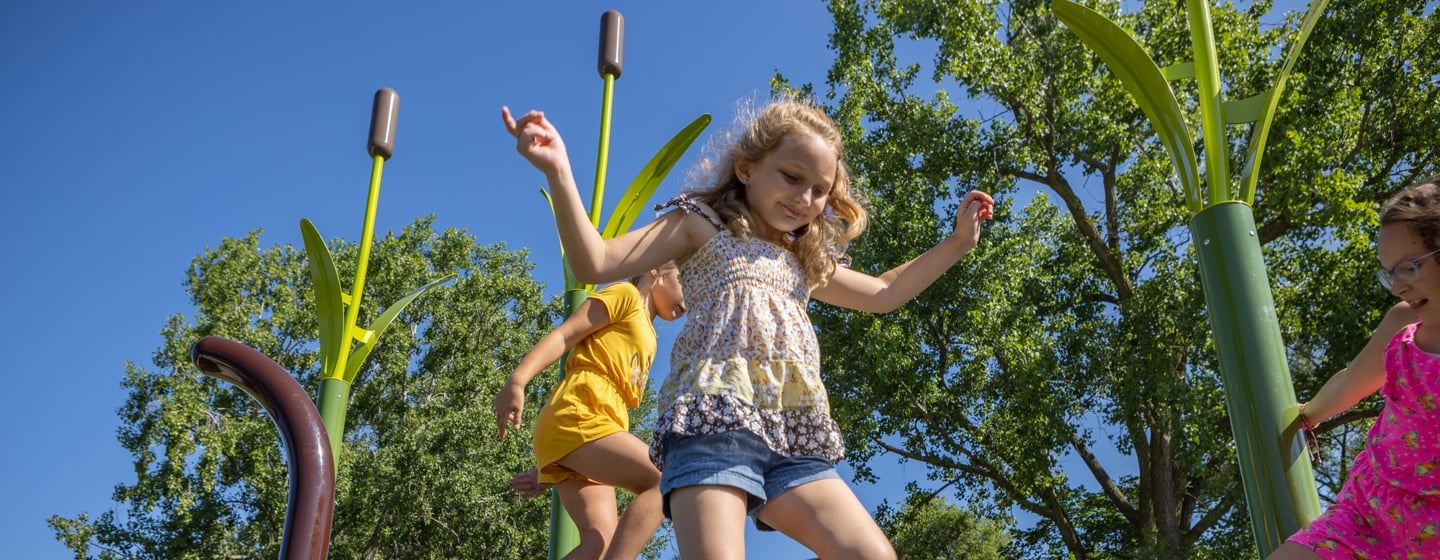
Nature is Everywhere
No matter where you live -- in the woods, on a mountain, near a field, along a cul-de-sac or in an urban area -- if you are outdoors, you are surrounded by nature.
 Outdoor play offers kids plenty of health benefits, because it increases physical activity1,2 and vitamin D levels3 and decreases obesity4 and the risk of myopia (nearsightedness).5,6,7 Furthermore, outdoor exploration promotes unstructured play, which is a key to executive function and creativity,8 while fostering curiosity, independence, and the ability to focus.9
But getting kids outdoors can be hard. Each day, kids spend 4-7 minutes in unstructured outdoor play vs. 7+ hours in front of a screen.9
Our play products are specifically designed to increase the time kids spend outdoors.
Landscape Structures playstructures and Aquatix® water play events blend the beauty and wonder of nature with the safety, age-appropriateness and durability found in manufactured equipment. This careful balance creates the optimal play environment. Adding SkyWays® shade to reduce heat and UV exposure allows kids to play even longer.
Color - We're Inspired by Nature
 The fledgling green of Sprout, liquid gold of Honey and bright warmth of Paprika. All Landscape Structures’ colors are inspired by nature, many with the names to match.
Strategic use of color can inform specific landscapes, seascapes, even airscapes. You may choose to blend in, like a desert-themed playstructure in a desert community; or stand out, like an underwater-themed playstructure in a prairie town.
Only Landscape Structures combines expert color leadership with a rich selection of proprietary colors.
Consider how the color palette for Smart Play® Summit™ takes you from the snow-tipped mountain tops, down rocky ledges, to the tree-lined meadow at the base.
Land - Nature is Everywhere
FORMA™
 Forma™ offers a contemporary way to express nature today. With abstract elements reaching out like branches of a tree, the Forma collection combines asymmetrical shapes, unique angles and a mix of materials to create endless play opportunities.
Build your one-of-a-kind naturescape by choosing your favorite components, from climbers, slides and swing frames to the Fox Den® Hangouts and Focal® Sensory Wall.
Then select the just-right color palette that transforms your structure into any environment you want, like a Southwestern scene, a wooded splendor or a metropolitan riverfront.
Naturally Urban
 Any city dweller with outdoor plants will tell you that bees inhabit the city, too; we just may not always notice them. But kids will notice a giant honeycomb climber in the middle of downtown.
It provides an innovative opportunity to explore the wonders of nature in a way that engages the imagination along with physical activity.
Or you might choose to introduce an unexpected natural setting, like planting a jungle-themed playground or African Safari-themed playstructure within a city park—the contrast is everything!
Topography
 What a difference a simple slope can make. Strategically positioned near slides and nets, it can provide additional access points while also acting as its own event for rolling down and climbing or crawling back up.
Rarely does the world around us appear flat and level. Use topography to add aesthetic and dimensional interest on the playground. For example, sloped safety surfacing can offer a colorful take on nature as well as provide important cues for kids with visual disabilities.
Whether covered in turf or safety surfacing, topography is a natural way to introduce inclusivity, allowing kids with upper-body strength to explore multiple levels of play.
Canyon Collection®
 These Glass Fiber Reinforced Concrete (GFRC) rock climbers fit into a variety of familiar landscapes, from desert outcrops to coastal shorelines. But they can bring a nature-inspired challenge to any setting.
Molded from actual rock formations, these realistic climbers offer kids a true-to-life rock-climbing experience at age-appropriate heights, with built-in hand- and toe-holds to encourage beginner and experienced climbers alike.
Choose from several preconfigured formations for some serious climbing adventure. Kids will love finding all the carefully sculpted fossils, stalactites and other cave dwellers.
More Realism with GFRC
 Using molds made from actual tree bark is just one way we bring realism to our GFRC creations. Our expert artisans can sculpt lifelike critters (from insects to whales), turn oversized mushrooms and maple leaves into whimsical steppers, and create cattail post toppers for that finishing touch.
Inform playful young minds with a playground based upon the natural history of your community or a nearby natural landmark.
Or simply add any of our many GFRC options, like mushroom and log steppers, acorn seats, tree climbers, and more.
Water-Inspired Play
A refreshing spray of water in the form of an overhead bucket on a splash pad or the intense blue of a seafoam-colored playground component both have the effect of a cooling and invigorating swim in the ocean or a lake. Bring the sensory experience of water to your play space with aqua-themed fun.
 Marine Themes
Nature-inspired play can be as simple as selecting a Smart Play® structure. The Smart Play collection includes five nature-inspired playstructures, including the fluidly playful BeachComber®.
You also can create a marine-themed playground simply by adding a Spring Rider made with DigiFuse® and creatively colorful surfacing. Or make it as unique as your quest for kids to learn about the local fishing industry in a playful way.
 GFRC on the Splash Pad
You can let any nature-inspired theme take root on the splash pad with a strategic combination of GFRC creations and classic spray features.
For example, create a watery woodland where a friendly bear welcomes splashers as they run amongst jets and sprays embedded in GFRC trunks, logs, and Aqua Rocks, like at Bear Branch Park in Woodlands, Texas.
GFRC may be a surprising choice for spray play, but it stands up well to hot sunny days and constant cool drenchings.
Bring Water to the Land

Establish a seaside scene within a landlocked community. Why not? The perfect color palette can make all the difference when it comes to capturing your aquatic-themed dream.
Add a sunny, comical fish that kids can climb on, up, through and across. Or enhance our Cozy Dome® with a unique turtle head to fully set the scene. Wavy poles go with the underwater flow. See more at Conejo Creek North Park, in Thousand Oaks, California.
Splash Play Inspiration

Splash pads and water-inspired themes go hand in hand, and they’re welcome everywhere hot summer days are a thing. A lush aquatic color palette and a few shoreline flower sprayers bring the H2O theme to fruition, like at Riverside Park in Kamloops, British Columbia, regardless of your proximity to the sea.
Combine Mobius® Climbers in creative ways to build a boat featuring a scaleable prow and stern and porthole panels, like at Bohol Circle Immigrant Park in Alameda, California.
Air - Inspired by Sky
One of the best parts of playing outdoors is the smell of fresh air. Capture the energy of the sky and clouds with climbable soaring play towers and preconfigured structures that reach up high. Joyful flushed cheeks and breathless fun will result.
 Billows® & Breeze®
Don’t forget to look up! Set a pair of fanciful, preconfigured structures side-by-side to entertain kids ages 2 to 5 and 5 to 12 with a theme of floating through the air. See more at the Epcot 2022 International Flower and Garden Festival in Lake Buena Vista, Fla.
Smart Play® Billows® and Breeze® playstructures are a great way to express a theme. Puffy clouds, an elevating kite and a balloon ready to take off are all part of the package.
Aside from soaring imaginations, there’s plenty of climbing and sliding fun. Add one or more freestanding play components for even more excitement.
 Towering Heights
Reach new heights with the Volo Aire™ preconfigured play tower. A related color palette creates an airy atmosphere as kids feel like they’re climbing into the sky itself. Plenty of sightlines along the way make for brilliant views as kids claim their favorite spots to perch.
Or, opt for sculptural clouds like those atop the Netplex® and PlayBooster® playstructures at Bicentennial Park in Hawthorne, California. Stunning from a distance, they offer equally spectacular views as kids climb through the netted interior all the way to the top.
Localize & Personalize
A great way to ground your playground project in nature is to reflect the local surroundings, colors, landscape and history around you. Consider bringing in elements that highlight the natural environment in your specific community.
 Upgrade the perforated panel on the Volo Aire™ with a nature-inspired image like leaves, zen waves, mountains or clouds. Then let the color palette do the rest of the work.
DigiFuse® panels are a cost-effective way to add nature in ways that are engaging, unexpected, even educational. Add a nod to nature with an imaginative DigiFuse panel, Permalene® accent, or both. Or incorporate Animal Tracks-themed DigiFuse panels plus scattered medallions for seek-and-find fun.
Use creative shade solutions to bring the theme home--or become the theme all by themselves.
References
Explore these resources highighting the immense value that outdoor play has on the developing bodies and minds of children.
- Hartig et al, (2014). Nature and health. Annul Rev Pub/Health, 35, 207-28.
- Christian et al, (2015). The influence of the neighborhood physical environment on early child health and development: A review and call for research. Health Place, 33, 25-36.
- Dadvand et al, (2014). Inequality, green spaces, and pregnant women: Roles of ethnicity and individual and neighbourhood socioeconomic status. Environ Inter, 71, 101-108.
- Agay-Shay et al, (2014). Green spaces and adverse pregnancy outcomes. Occup Environ Med, 71(8), 562-9.
- French et al, (2013). Time outdoors and the prevention of myopia. Exp Eye Res, 114, 58-68.
- He et al, (2015). Effect of time spent outdoors at school on the development of myopia among children in China. JAMA, 314(11), 1142-1148.
- Dolgin, (2015). The myopia boom: Short-sightedness is reaching epidemic proportions, Some scientists think they have found a reason why. Nature, 519, 276-278.
- https://www.horizonhealthnews.com/the-truth-about-children-andoutdoor- play/
- https://news.sanfordhealth.org/childrens/play-outside/
 Oops! The Internet Explorer (IE) browser is no longer supported.